
Timothy Hulbert was born on October 2, 1789, in Pittsfield, Massachusetts to Timothy Hulbert and Mary Robbins. He was the fourth of fourteen children born to the couple. The elder Timothy was a carpenter and had learned the trade from master carpenter Josiah Francis. He likely passed this skill down to his son Timothy, who worked as both a carpenter and joiner. A carpenter possessed the building skills to create the frame of a structure, but a joiner brought the beauty to the building with detailed elements such as moldings, mantels, and staircases, so Timothy had capabilities that would be in demand when he left home and moved to Truxton.
In 1809, Timothy’s mother Mary died, and within the year, he made his way to Truxton where he purchased a “half acre on the west side of the turnpike road in Truxton hamlet” from John Miller for $40 in U.S. currency. In the early years of the United States, currency of all kinds was being used in transactions, so it is interesting that the deed specifies that U.S. currency was used for the transaction. Timothy’s older brother Stephen was one of two witnesses to the property transaction. Sometime between this first land purchase and 1817, Timothy and Stephen migrated further west to West Bloomfield, New York. Here the brothers met and married sisters; Stephen married Lurana Miner in 1815, and Timothy married Mehetible Miner in 1817. While it is unclear as to the reason for the migration further west, it is possible that the brothers were keeping their options open, exploring areas they felt would provide them with success in their lives.
After Timothy and Mehetible married, they moved to Truxton, where they welcomed their first child, daughter Emily Eliza, in March of 1818. Their family continued to grow, and eventually there were eight children to care for, though the Hulberts’ only other daughter, Paulina, died at the tender age of one. Between 1825 and 1840, the family moved from a sixteen-acre improved lot to a village lot that was just a third of an acre. This move coincides with the construction of the Hulbert home at what is now 3765 New York State Route 13. Four additional homes built by Timothy Hulbert are clustered in this section: 3757, built for Samuel Stiles; 3761, built for Charles Parker; 3760, built for Billy Trowbridge; and 3766, built for Austin W. Otis. These five homes were all built during the 1830s and were subject to study by graduate students in Cornell University’s Preservation Planning Workshop. The discovery of five houses built by the same craftsman was a rare opportunity to examine one man’s work and makes for fascinating reading.
In addition to building houses, Timothy Hulbert speculated in real estate, where he bought, sold, and financed properties in the area. There were 21 property transactions from 1813-1841 for Hulbert, but his financing isn’t indicated in any of these particular transactions. At the time of his death, he held over $6,000 worth of mortgages and notes for local properties, the equivalent of a quarter million dollars today. He was a successful businessman and reaped the rewards of his hard work.
Hulbert was active in his Truxton community through his membership and leadership in the Presbyterian Church as well as through his militia service in the 124th Regiment of the New York State Militia where he was ensign, lieutenant, and captain at various times. His commission making him captain was signed by Governor DeWitt Clinton. He “was a Democrat of an uncompromising type” and represented Truxton on the county board of supervisors for several years. Hulbert was a one-time candidate for member of the assembly, though it is unknown as to why he did not pursue that path further since he was obviously devoted to representing his community through his service on the board of supervisors.
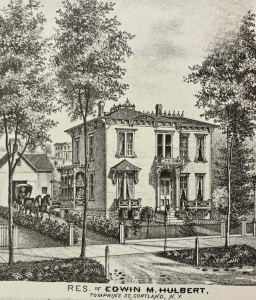
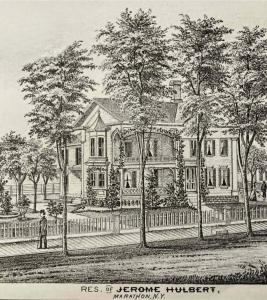
Of the children of Timothy and Mehetible, none of the boys followed their father’s footsteps into the carpenter’s or joiner’s trade, but it appears as though all of them went into the produce industry. Two of their sons, Jerome and George, oversaw purchasing for William Hulbert and Brothers, which was headquartered in New York City. Brothers Jerome and Edwin were successful enough to have their houses featured in the 1876 Atlas of Cortland County. Emily Eliza, the oldest daughter of Timothy and Mehetible, came the closest to following family tradition. She married Austin Pomeroy of Truxton, a woodworker, cabinetmaker, and part time undertaker.
Timothy died on May 20, 1848, and his will was made out two weeks before his death. It is likely he was ill and knew he must ascertain his business was tidy when he departed from this world. Reading a will offers a glimpse into the world of the deceased and the things which are close to their heart, and Timothy’s will showed his love and concern for the well-being of his “beloved wife Mahitable.” He included provisions for her financial well-being that were detailed, and he left considerable provisions for his children as well. Listed in the property inventory of Timothy Hulbert were “12 changes of dress for the widow,” indicative of a comfortable amount of clothing. There were a spinning wheel and hatchel, which lets us know that Mehetible probably made some of the family clothing or bedding. Several looking glasses, a tea set, a bounty of furniture, and even a ring were included in the inventory as well as a fully stocked pantry. For a carpenter’s family in rural 1840s America, the Hulbert family was flourishing.
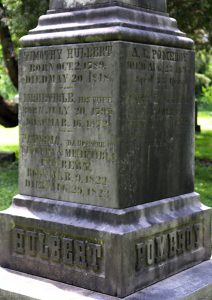
Mehetible never remarried, and she died on March 16, 1872. Both she and Timothy are at rest at the Truxton Rural Cemetery with a simple, yet elegant obelisk to mark their sojourn on earth. ~ By Tabitha Scoville, CCHS Director
Note on spellings: Hulbert is a surname that has morphed and changed by the generation and event within the same family group. Timothy’s father’s headstone is “Hurlbert,” and others used “Hurlbut.” Timothy’s wife, Mehetible, is spelled at least three different ways in sources, so the one used in this article is the one on her gravestone.