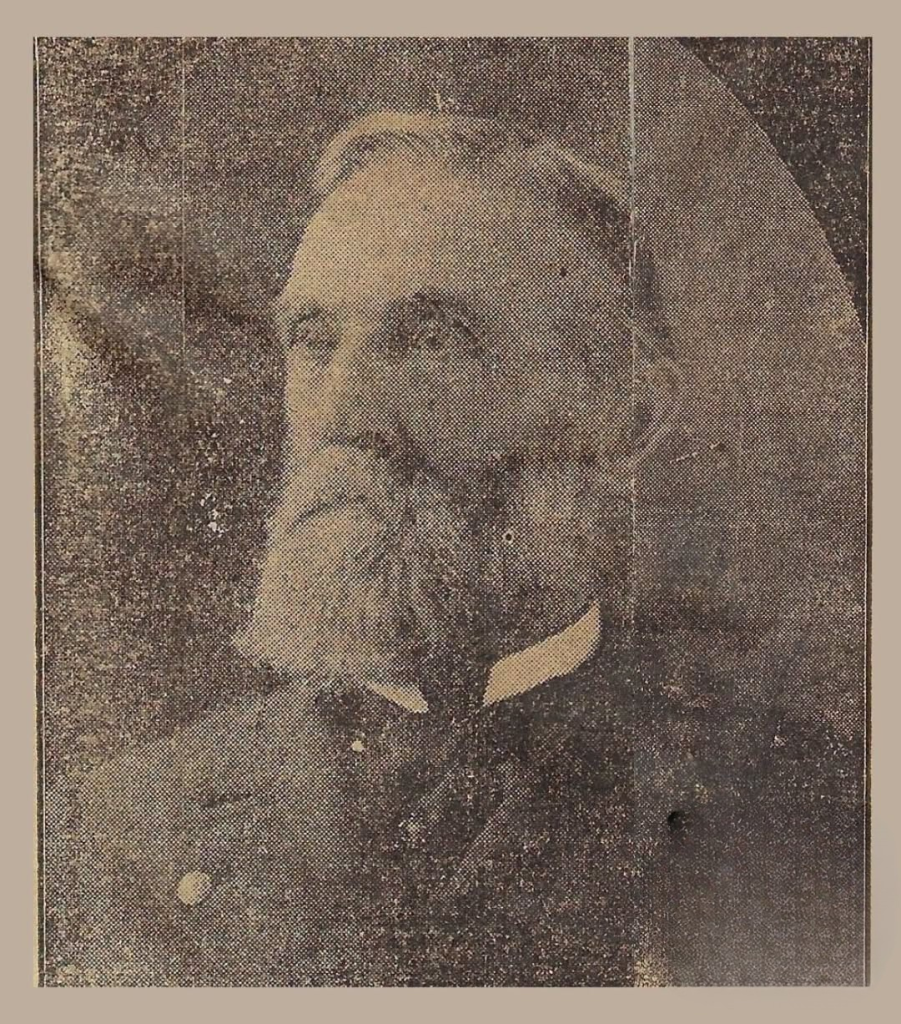
 Born on September 12, 1826, Charles Orville Newton was the oldest of five children born to John Newton and Mary Maria Prince. The family lived in Brimfield, Massachusetts, at the time of Charles’ birth, where he was educated in the public schools, later attending the nearby Monson Academy. When he finished school, Charles clerked at his father’s store for a while before deciding to move to Homer in the autumn of 1851. In November of 1852, he married his first cousin Elizabeth Newton in her family home at 46 North Main Street in Homer. Elizabeth’s parents had come to Homer from New England in 1816, thus making them some of the earliest settlers to the village. Charles’ father John and Elizabeth’s father Lemuel were brothers.
Elizabeth Newton was born in Homer on August 7, 1824, to Lemuel D. Newton and Betsey Merrick. She was an only child and received her education at both the Cortlandville Academy and the Pompey Academy. While in Pompey, she lived for a year with a local attorney and his family. In 1844, she spent a year in Indiana, and in 1851, she spent a year in Massachusetts with relatives. Perhaps it was with her cousin Charles’ family with whom she stayed since the very same year, Charles moved to Homer, and they were married the next year.
Once in Homer, Charles began a mercantile business, which was quite successful. He became involved in community affairs, serving as the town clerk and later as the village president. When the Civil War erupted, Charles did not hesitate to join the Union Army, where he mustered in as quartermaster sergeant in the 157th New York Infantry in September of 1862. He signed on for three years but was discharged in June of 1863.
Charles and Elizabeth were well matched and would enjoy a long and happy marriage that withstood devastating grief. They were the parents of two boys, William S. (born 1856) and Frank Merrick (born 1862). Unfortunately for the Newtons, both of their sons died young. William was six years old when he died, and Frank was thirty-six when he was killed in a horrific accident. Despite their broken hearts, or perhaps because of their losses, Charles and Elizabeth were kind and generous people who gave back to the community that had supported them through their grief.
Because Charles was so successful in his business ventures, he and Elizabeth were able to make significant contributions to improve the village. In 1902, they purchased the Homer Water Works for $30,000 and donated it to the village. This was a landmark event for Homer that gave the village control over its water system, which had previously been owned by outside investors. The village had been paying $2,000 annually for use of its hydrants, and the savings from that would more than pay for the operation of the plant itself. To honor the generous gift from Charles and Elizabeth, the facility was renamed Newton Water Works. Another important gift from the Newtons was the park at the corner of Cayuga and Bartlett, which was formerly a swampy and undesirable location filled with refuse and squatters occupying ramshackle buildings. The condition of the donation was that the citizens, particularly those in the neighborhood, clean up the area to prepare it for grading, landscaping, and its new life as a public park.
In addition to improving village infrastructure, Charles and Elizabeth also contributed to the spiritual life of Homer. They donated money to the Homer Congregational Church for a pipe organ as well as an endowment to keep it in good working order. When a Catholic church was being built in Homer, Charles donated $1,000 and asked that the church be called St. Margaret’s after Margaret Phalen Butler, longtime housekeeper and caregiver for the family.
As a veteran of the Union Army, it was important to Charles to honor the lives of the men who served, and he and Elizabeth presented a plot of ground at the top of the hill at Glenwood Cemetery as a burial place for soldiers who did not have the means for a proper burial. On Memorial Day in 1906, he had a monument of his own design presented with ceremony with this inscription: “In memory of the soldiers and sailors here, who fought to save the Union, 1861-1865.” The monument was later moved near the entrance of the cemetery.
Philanthropy was a uniting theme in their marriage, though in some ways, Charles and Elizabeth pursued their own interests. Charles was involved in politics in one way or another for much of his life. He helped organize the Cortland County Republican Party in 1856 and twice served as a member of the New York State Assembly. In addition to serving as village president and town clerk, Charles served in other leadership positions in the community. He served as president of the Phillips Free Library Association, as president of the Glenwood Cemetery Association, and as a trustee of the Homer Academy. Many of Elizabeth’s interests revolved around her church and her home. She was an active worker in the Congregational Church and its Sunday school. She was a life member of the Women’s Home Missionary, and she served as the first president of the board of directors for the Home for Aged Women. The home Charles and Elizabeth shared was that in which Elizabeth had been born, and it was as much a part of her as she was of it. The major milestones of her life occurred within its walls from her birth to her marriage to the births of her children to her own death. If only walls could speak, what more of the joys and sorrows of their lives could we learn from the former Newton home!
Well known and loved, Elizabeth died in 1907 and was remembered as “a mighty power for good in the community.” Charles died in 1917, and this was said of him: “He was a fine-spirited Christian man of the strictest integrity—a man who scorned to do a mean, dishonest, or dishonorable thing. He had the courage of his convictions and was never afraid to speak his mind.” Doing the right thing was always the path chosen by Elizabeth and Charles, and Homer is a better community today because of the magnanimous contributions of the Newtons.
If you like, you may pay your respects to the Newton family at Glenwood Cemetery, where they are at rest together for all eternity. ~Tabitha Scoville, CCHS Director